Language reference frameworks: the 2026 comparative guide

A candidate presents an IELTS score of 6.5. A student returns from an exchange programme with a JLPT N2. A colleague mentions an Advanced level on the ACTFL scale. All of these describe a language level — but they don’t speak the same language. Understanding how these frameworks relate to each other has become a skill in its own right for anyone overseeing language assessment in a professional or academic setting.
This guide compares the main reference frameworks used around the world, explains how they map onto the CEFR, and helps you choose the right tool for your context. If you would like to see how a platform built for professionals handles these different scales, you can request a free demo of ELAO.
The CEFR: the common reference point against which everything else is compared
The CEFR (Common European Framework of Reference for Languages) is the only framework created by an intergovernmental organisation — the Council of Europe. Published in 2001 and expanded with a companion volume in 2018, it describes language skills on a six-level scale, from A1 to C2, and applies to every European language.
Today it is the dominant reference in Europe for teaching, training, and recruitment. Most other tests and frameworks publish mapping grids against the CEFR, which naturally positions it as the pivot of any comparison.
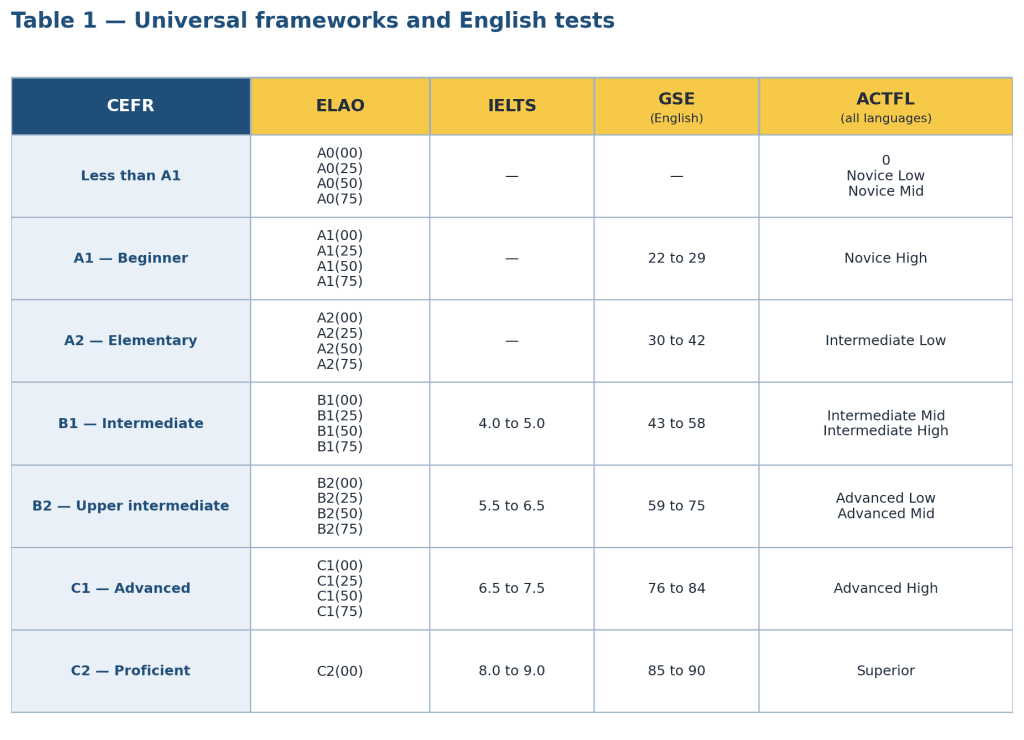
One limitation often encountered in practice: the CEFR bands are wide. Two learners classed as B1 can have very different profiles. Some tools have therefore developed sub-levels to refine the reading. ELAO, for example, offers quarter-level granularity — B1(00), B1(25), B1(50), B1(75) — which enables far more precise placement decisions, particularly when forming homogeneous groups or comparing candidates within the same level.
The main frameworks for English
IELTS and the Cambridge English Scale
The IELTS (International English Language Testing System) was developed in partnership with the University of Cambridge. Its scale runs from 0 to 9 and covers all four skills: listening, reading, writing, and speaking. It is particularly used for university admissions in English-speaking countries and for certain immigration procedures.
Cambridge exams (B2 First, C1 Advanced, C2 Proficiency) use the Cambridge English Scale, a numerical scale from 80 to 230 points. Unlike IELTS, each exam targets one specific CEFR level.
TOEFL and TOEIC
The TOEFL (Test of English as a Foreign Language) and the TOEIC (Test of English for International Communication) were both created by ETS (Educational Testing Service). TOEFL targets academic contexts, while TOEIC targets professional contexts. Each uses its own scale and publishes mapping grids against the CEFR.
Worth noting: TOEFL introduced a new scoring scale in January 2026, moving from a 0–120 scale to a 1–6 scale in increments of 0.5. The old and new scores will appear side by side on reports during a transition period running until 2028.
GSE — Global Scale of English
Developed by Pearson, the GSE runs from 10 to 90, offering a finer grain than the CEFR. It is aligned with the CEFR and allows you to pinpoint a learner’s position within a level, whereas CEFR bands remain broad. The GSE is designed exclusively for English and tailors its objectives to four learner profiles: general adult learners, professional English, academic English, and young learners.
ACTFL
ACTFL (American Council on the Teaching of Foreign Languages) is the North American reference for language assessment. Its scale runs from Novice Low to Distinguished and covers five main levels: Novice, Intermediate, Advanced, Superior, and Distinguished, each split into Low, Mid, and High sub-levels.
In 2024, ACTFL published a revised version of its Proficiency Guidelines — the first update since 2012. The levels and sub-levels remain unchanged, but the descriptors have been clarified and brought into line with current assessment practice.
Frameworks for other languages
HSK for Mandarin Chinese
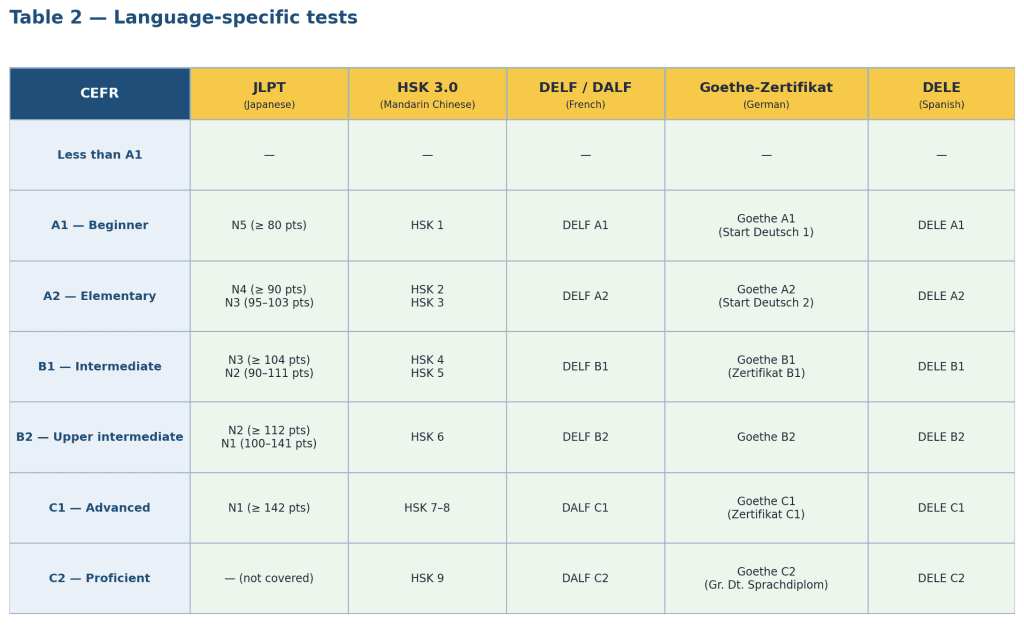
The HSK (汉语水平考试 — Hanyu Shuiping Kaoshi) is the official proficiency test for Mandarin Chinese, run by the Chinese International Language Council. Since its reform in 2021, it has offered a 9-level scale (HSK 1 to 9), grouped into three broad bands: beginner (1–3), intermediate (4–6), and advanced (7–9). HSK 1 to 3 roughly correspond to CEFR A1 to B1, HSK 4–6 to B2–C1, and HSK 7–9 to C1–C2.
DELF and DALF for French
The DELF (Diplôme d’études en langue française) and DALF (Diplôme approfondi de langue française) are official certifications awarded by the French Ministry of Education. Directly modelled on the CEFR (A1 to B2 for the DELF, C1 and C2 for the DALF), they are recognised worldwide for studies in France and for immigration procedures. Unlike time-limited tests, the DELF and DALF diplomas are held for life.
Goethe-Zertifikat for German
The Goethe-Institut issues certifications for every CEFR level, from A1 to C2. They are used in particular for university admissions in Germany and for some visa procedures. They assess all four language skills and are recognised by employers and academic institutions throughout the German-speaking world.
DELE for Spanish
The DELE (Diplomas de Español como Lengua Extranjera) is awarded by the Instituto Cervantes on behalf of the Spanish Ministry of Education. It covers CEFR levels A1 to C2 and is the benchmark certification for Spanish in both academic and professional settings.
JLPT for Japanese
The JLPT (Japanese Language Proficiency Test) is run by the Japan Foundation. Its scale goes from N5 (beginner) to N1 (advanced). Since December 2025, score reports now include an official mapping with CEFR levels, from A1 to C1. This change makes the results easier to recognise internationally, although the JLPT does not cover speaking or writing skills.
Comparative table of equivalences
* Official JLPT/CEFR equivalences in place since December 2025 (Japan Foundation). Based on total score, excluding speaking and writing skills. C2 is not covered by the JLPT.
** HSK 3.0 (9 levels) has been rolling out worldwide since November 2025. The mapping against the CEFR is indicative: HSK/CEFR equivalences are debated among experts, particularly at the advanced levels. The former HSK 2.0 system (6 levels) is still in use in many contexts.
*** DELF, DALF, Goethe-Zertifikat, and DELE are directly modelled on the CEFR: each certification corresponds exactly to one level.
The equivalences shown here are indicative. Each test measures skills in different formats and with different reference populations. An IELTS score of 6.5 and a B2 level on ELAO describe a similar linguistic reality, but they are not strictly interchangeable: one targets academic English with speaking and writing components, the other assesses several skills separately through an adaptive format. These nuances matter for placement and admission decisions.
Which framework should you choose for your context?
Choosing a framework depends less on how well-known it is than on how you intend to use it. Here are the most common situations.
For corporate recruitment, the CEFR remains the most practical reference in Europe. It allows you to set the required level for a role precisely and to compare candidates objectively. A CEFR-aligned tool like ELAO slots straight into a recruitment process with no need for conversion.
For university admissions in an English-speaking country, the IELTS or TOEFL remain the references expected by institutions. If you are assessing your own students before an exchange programme, a CEFR-based test is enough to establish their starting level and check the prerequisites of partner universities.
For building level groups in a training centre or university, the granularity of the result matters more than the framework itself. A simple B1 label does not distinguish a solid learner from a fragile one at the same band. This is where tools offering sub-levels deliver tangible value.
For immigration and naturalisation, requirements are set by national authorities. In Belgium, for example, the language tests required to obtain Belgian nationality are delivered through the ELAO platform in Forem’s regional directorates.
For languages other than English, the CEFR remains the common reference, with national certifications (DELF, Goethe, DELE, HSK) aligned to it. If you assess several languages within the same organisation, a multilingual tool aligned with the CEFR dramatically simplifies the reading and comparison of results.
What equivalences don’t tell you
Comparing frameworks also means accepting their limits. Several points are worth keeping in mind.
The same level does not guarantee the same skills from one test to another. The JLPT only assesses listening and reading; an N2 score tells you nothing about the candidate’s ability to speak Japanese. The TOEIC measures passive professional English, not the ability to negotiate in an international meeting.
Equivalences are calculated on reference populations, not on individuals. A learner may end up at a slightly different IELTS level than their CEFR score would predict, depending on their skills profile.
Lastly, score validity varies. Tests such as TOEFL and IELTS are valid for two years. DELF, DALF, and Cambridge certifications are held for life. For institutional use, this detail can make a real difference.
FAQ
What is the difference between a reference framework and a language test?
A reference framework like the CEFR is a system for describing language skills. A language test is a measurement tool that can be aligned with one or more frameworks. IELTS, TOEFL, and ELAO are tests: they produce a score that can then be placed on the CEFR or another scale.
Does the CEFR apply to every language?
Yes. The CEFR was designed for all European languages, but it is now used well beyond Europe — including for Japanese (through the JLPT since December 2025) and Mandarin Chinese (through the HSK, whose scale is aligned, albeit approximately).
Can you directly compare an IELTS score with an ELAO score?
Both can be mapped via the CEFR, but they do not measure exactly the same thing. IELTS assesses English through speaking and writing tasks, while ELAO assesses several skills separately and offers quarter-level precision. For recruitment or placement, ELAO delivers finer, immediately actionable information in a multilingual context.
Since when has the JLPT been aligned with the CEFR?
Since the December 2025 session. The Japan Foundation introduced an official mapping between JLPT scores and CEFR levels (from A1 to C1). This indication now appears on the score reports of candidates who pass their level.
How do you choose between TOEFL and IELTS for university admission?
Both are widely accepted. TOEFL is often preferred for the United States, IELTS for the United Kingdom, Australia, and Europe. If both are accepted, the choice can come down to the format: TOEFL is taken entirely on computer, while IELTS includes a face-to-face speaking test with an examiner.
Conclusion
Navigating between language reference frameworks is no trivial matter: misreading an equivalence can lead to an unsuitable placement, a poorly calibrated recruitment requirement, or a questionable admission decision. Understanding what each framework measures — and what it does not — is the starting point of any rigorous language assessment.
For organisations that assess several languages and profiles, a tool designed by linguists and aligned with the CEFR makes this work much easier. If you would like to see how ELAO fits into your assessment processes in practice, contact us for a personalised demo.