How to set the target language level for higher education students

Teachers and linguists regularly ask themselves the same question: how can we measure learner progress? What level can students realistically aim for? How do we set that target? And how can we make sure it matches the reality of today’s students and today’s world? This article sets out our answers.
The starting point: the CEFR inverted pyramid
Most European students are assessed against the Common European Framework of Reference for Languages (CEFR). This framework defines a set of levels, each corresponding to a specific language stage, from A1 (Breakthrough or false beginner) up to C2 (Mastery). To sharpen the precision of the result, some language tests add sub-levels — as ELAO does (see here).
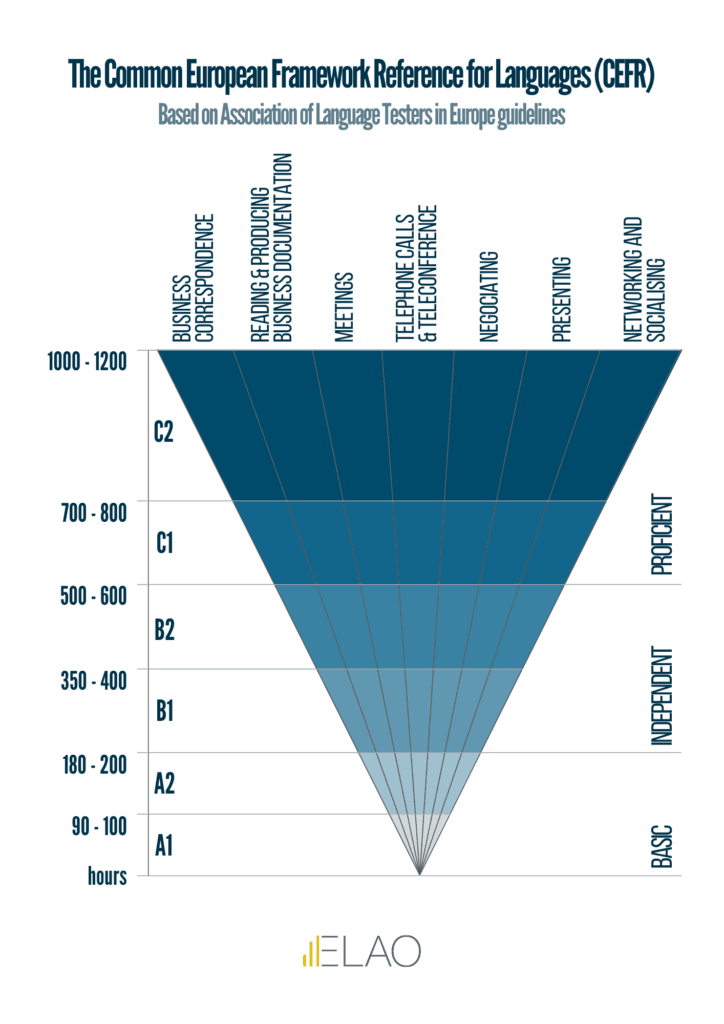
One thing is certain: climbing the CEFR ladder takes time. But exactly how long? The valuable data shown in the graphic below gives a solid starting point for setting a coherent and realistic learning objective.
For example, if your students are at A2 at the start of the year and attend four hours of class with two hours of home study per week, that adds up to 216 hours of work over the 36 weeks of a school year. In theory, they could therefore reach B1 by the end of the academic year. Of course, these are only theoretical figures, and they need to be put into context: several factors can influence how quickly someone learns.
The factors that influence a student’s learning time
We have identified four factors that play a major role in a student’s learning time:
Motivation
A learner’s personal involvement has a huge impact on how long it takes to learn a language. An hour of work done by someone passionate and engaged will feel far more productive and far less demanding than an hour put in by someone with weaker motivation.
Here are a few ways to boost a student’s motivation to learn a language:
- Introduce them to the culture and way of life of the countries where the target language is spoken.
- Explain why learning the target language will be useful in their future professional life (CV, career choices, career progression) and personal life (travel and new encounters).
- Tie the language to their everyday life (encourage them to watch series, listen to podcasts, or read books in the target language).
- Share anecdotes linked to the language and to their field of study. For marketing students, for instance, you could show examples of translation blunders in international campaigns.
The student’s age
Most students are young, so we can generally assume they have no particular difficulty studying and memorising content. That said, more and more adults are also following academic courses. For older learners, the process can take slightly longer.
The average starting level
It is essential to know your learners’ starting level, because the higher the CEFR band, the longer it takes to move to the next one. Moving from C1 to C2, for example, takes an average of 400 to 500 hours of work, whereas moving from A1 to A2 can be achieved in just 100 hours. To establish your students’ level at the start of a course, you can rely on tools such as ELAO.
The learning context
The learning context also influences how quickly a student progresses. Several factors come into play, including:
- Culture: some cultures encourage foreign language learning far more than others. English speakers, for example, often approach language learning less seriously, since they already speak the international language.
- Location: students living close to a linguistic border are often more motivated to learn both of the languages involved.
- National policy: countries with several official languages often encourage their citizens to master all of them.
- Globalisation: English has become the global reference language, its learning is widely encouraged, and students are more motivated to pick it up.
In conclusion
The pyramid presented here is an excellent starting point for estimating the workload needed to move from one language level to the next. It is also a useful benchmark for setting student objectives based on the teaching hours available in your curriculum. Be sure, however, to take each student’s real context into account and adjust the targets accordingly. By defining SMART goals (Specific, Measurable, Achievable, Realistic, and Time-bound), teachers give their students the best possible chance of making the most of their course.